

TECHNICAL REPORT
SURGICAL CAMP 1 – 9 OF MAY, 2025 IN SIERRA LEONE KINGTOM POLICE HOSPITAL (FREETOWN, CAPITAL OF SIERRA LEONA).
DATES AND LOGISTICS
Freetown, the capital of Sierra Leone, is a destination where the Surgeons in Action Foundation has established ties since 2019 in collaboration with Hernia International foundation, when the first surgical campaign was carried out in this city in this West African country. Like every expedition led by Dr. César Ramírez, this mission has been ‘powered’ by the “Bisturí Solidario” Foundation, which is chaired by the surgeon, allowing it to cover a large part of the team’s expenses, transport a large amount of material, and meet the hospital’s surgical needs.

The health centre where the campaign was carried out was the Kingtom Police Hospital in Freetown, a facility belonging to the police, an institution with considerable influence and power throughout the country. In the past, this hospital only treated members of the police force and their families, but in recent years it has extended its medical services to the entire population of the area.

Dr. John Konteh (Deputy Director & Medical Superintendent) is in charge of Kingtom Police Hospital. He is an endocrinologist with extensive experience and training in London (England), which gives him a broad view of the global health situation and that of his country. He has been the person with whom we have managed all the preliminary preparations, accommodation, transport logistics and patients, whom he has been able to bring together through a prior appeal, gathering more than 250 people, taking into account the duration of the campaign. Prior to the campaign, Dr. Konteh sent us the necessary documentation to obtain a temporary residence permit in Sierra Leone, as well as another individual form from the police so that we would not have any problems upon arrival at customs.

Unlike other countries, obtaining a visa is very straightforward. You can apply online via the official government website www.evisa.sl and pay electronically ($80). In our case, none of the members of the expedition had any problems when applying for it. Once the application is completed and the payment made, the visa with its confirmation is received by email within 2-3 days.

The trip was organised by Quest Viajes through Silvia Bayolo, who manages the expedition flights in collaboration with Bisturí Solidario. Due to Sierra Leone’s geographical location, flights to Central or West Africa require a stopover in Casablanca (Morocco) operated by Royal Air Maroc. Departing from Spain from various points (Malaga, Gran Canaria, Madrid and Barcelona), the Moroccan capital was the meeting point for the entire expedition on 1 May, arriving in Freetown in the early hours of 2 May. It is noteworthy that Freetown International Airport (the largest in the country) is separated from the city by the sea, so the best way to get there is by bus, which drops you off at a small port where you can take a ferry to the city, which costs £50 per person.

On the afternoon of the same day of arrival, the surgeries begin, starting the first of six days of operations. Thus, until Thursday, 8 May at noon, surgeries are performed every day from 8 a.m. until nightfall.

The return journey, due to flight connections, takes place in the early hours of Friday 9 May at 5:25 a.m. to Casablanca, on a flight lasting just under five hours, the same as the outward journey. Once at the Moroccan airport, we began saying our goodbyes, as, just like on the way there, we were flying to Malaga, Madrid, and Barcelona.

Considering that there were 16 of us travelling, each with two 23 kg bags, we transported a total of more than 700 kg of material and equipment to carry out the campaign, including medication (NSAIDs and more than 100 boxes of levothyroxine to treat cases of total thyroidectomy that had been operated on), three Ligasure vascular sealing generators, and three multiparametric monitors.

As for accommodation, as in previous campaigns carried out in Freetown, we stayed at The Jam Lodge for the six days of the campaign, a hotel with large single rooms, decent bathrooms and air conditioning that allowed for a good night’s sleep. It also has a small leisure area and a gym. It is clear that this is a hotel that caters to wealthy locals and foreigners due to its price (€70 per night with breakfast included, thanks to a negotiated 5% discount for each of us as a large group).

It takes about 10 minutes to get from the hotel to the hospital, depending on traffic (much less at night than during the day). For this transport, we had a large 20-seater van, which could accommodate all of us and Abumarah, a member of the police force and a trusted person who accompanied us everywhere and provided security.
NUMBER OF PATIENTS TREATED
During the seven days of the campaign, a total of 196 patients were treated, undergoing 221 procedures.

Adult patients: 176 procedures were performed on 160 patients, mostly men, aged between 18 and 87 years.
Paediatric patients: 45 procedures were performed on 36 patients, aged between 3 and 18 years.
Surgeries/procedures performed:
- Thyroidectomies:
- o Total: 13
- o Near-total: 2
- o Subtotal left: 10
- o Subtotal right: 3
No patients presented symptoms of hypocalcaemia in the immediate postoperative period during our stay, and only two patients who underwent total thyroidectomy had mild dysphonia the day after surgery. No patients presented postoperative haematoma requiring reoperation.

- Hernias:
- R Inguinal: 55
- L inguinal: 35
- Bilateral Inguinal: 17
- Umbilical: 29
- Supraumbilical: 5
- No patient required reoperation due to complications. One patient, aged 74, with a giant inguinal-scrotal hernia containing the entire abdominal contents, developed sepsis due to bacterial translocation and died immediately after surgery. The patient underwent reoperation due to poor progress, and no notable digestive complications were observed.
– Others:
o Lipomas: 13
o Cryptorchidism: 4
o Adenopathies: 3
o Lymph nodes: 2
o Hydrocele: 8
o Hypoplasia: 1
o Cysts: 5
o Soft tissue tumours: 2

THE PLACE
The Republic of Sierra Leone is a country located on the west coast of Africa, with an area of approximately 71,740 square kilometres. Its population exceeds 8 million, making it a relatively small country in terms of both size and population compared to others in the region. It borders Guinea to the north and east, Liberia to the southeast, and the Atlantic Ocean to the west.
Sierra Leone gained independence from the United Kingdom on 27 April 1961. Throughout its history, it has experienced periods of political instability, including an armed conflict between 1991 and 2002, which left deep social and economic scars. Since the end of the civil war, the country has made progress in consolidating democratic institutions, holding regular presidential and parliamentary elections.
Sierra Leone is a presidential republic divided into 5 administrative regions and 16 districts. The official language is English, although most of the population communicates in Krio, a Creole language widely spoken and understood throughout the country. Sierra Leone is a multicultural and multi-ethnic state, with significant groups such as the Mende, Temne, Limba, among others. Religion is also evenly distributed between Muslims and Christians, coexisting with remarkable interreligious respect.
Despite its natural resources, such as diamonds, bauxite, gold, and iron ore, Sierra Leone’s economy remains one of the poorest in the world. Its GDP per capita is among the lowest on the planet, and the country ranks low on the UN Human Development Index. However, international organisations recognise significant progress in health, education, and governance since the end of the conflict.
The capital, Freetown, is located on the peninsula of the same name, on the shores of the Atlantic Ocean. It was founded in 1792 as a settlement for freed slaves from North America and the Caribbean, and its name reflects its origin as a ‘free city’. Today, Freetown is the country’s main political, economic and cultural centre, with a population of over one million. Its natural harbour is one of the largest and deepest in the world, which has boosted its commercial role since colonial times.
During our recent stay in Freetown, we did not feel any immediate sense of danger, although caution is advised in less frequented areas or at night. The city faces challenges related to disorderly urbanisation, frequent power cuts and poor sanitation, but it also shows signs of dynamism and reconstruction. The country has managed to maintain peace and stability in recent years, although vigilance remains high in the face of political tensions and structural problems such as youth unemployment and corruption.
THE TEAM
Nuestro equipo ha estado compuesto por un total de 16 voluntarios:
– General Surgery: César Ramírez, Marta Roldón, Pablo Muriel, Jaume Ortega, Laia Codina (R5 of surgery) y Marta Domínguez (R3 of surgery).
– Anaesthesiology: Javier Mora, Ana Pascual, José Antonio Franco y Laura Herrero (R4 of anaesthesia).
– Nurses: Francisco Gómez, Leyre Gascón, Carlota Gómez y Juan Carlos Campos.
– Journalist: Javier Budi y Ana Vera.

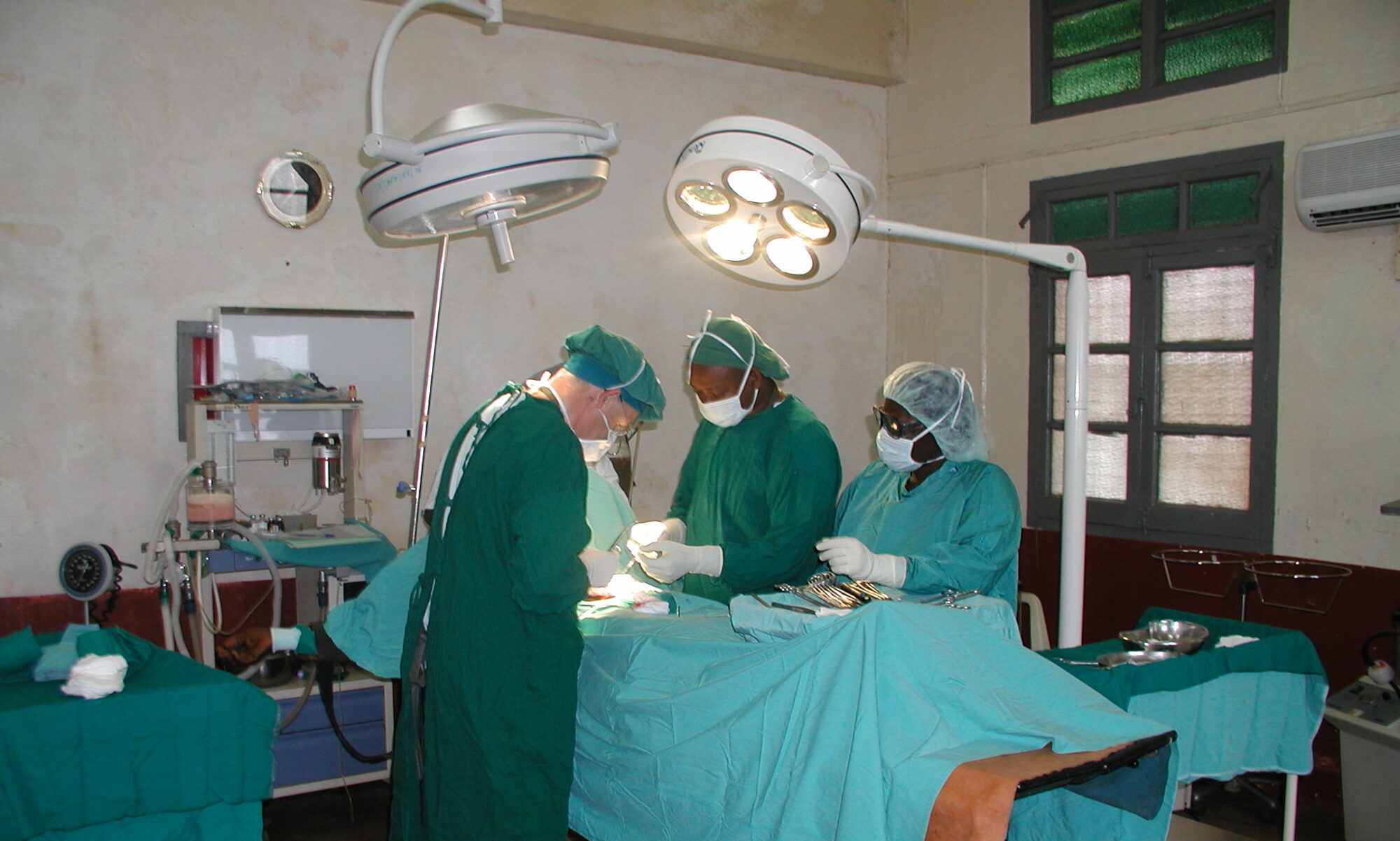
HOSPITAL. The Kingtom Police Hospital in Freetown consists of several modules, one of which is used for emergency services and basic primary care; another where patients with highly contagious epidemic diseases requiring isolation are treated and hospitalised; and a third with two floors consisting of various wards, the operating theatre divided into two modules with an adjoining room between them that serves as a sterilisation area.

The surgical area described consists of five parts: two separate operating rooms (one of which was used to accommodate two surgical tables); a sterilisation room; a small room where we had the computer to record the procedures and where we were served coffee and fruit; and a room with a refrigerator where we used to prepare meals with our provisions and store the equipment. Considering the technical difficulties encountered by the previous team (failing diathermy generators, unstable surgical beds, poor lighting, etc.), we decided to transport three Ligasure devices (the missing one was replaced by a diathermy generator from there), and we also made a donation from the Bisturí Solidario Foundation of a Dräger Atlan 300 anaesthesia machine (worth $40,000), as well as a surgical bed, a portable lamp and a medical air generator for the respirator (valued at $17,000). These donations were arranged before our arrival so that everything would be operational when the surgical sessions began.

EQUIPMENT. The surgical instruments available at Kingtom Police Hospital are practically non-existent. For this reason, our team has brought six boxes of instruments for the campaign so that we can work safely..
ASEPTIC CONDITIONS: Sterilisation was carried out using a thermal autoclave in the dedicated room. On the first day, due to the fast pace of work, the autoclave broke down and could not be repaired. A new one was quickly purchased, the cost of which ($550) was covered by the Bisturí Solidario Foundation. At the same time, the good work of the staff in the sterilisation area ensured that aseptic material was always available whenever surgery was required.

LOCAL STAFF: Dr. John Konteh, although absent from the surgical scene, has always been interested and attentive to any needs, obstacles, or problems that may arise. Within the surgical area, Unisa, as head of nursing and sterilisation staff, and Mary, as Dr. John Konteh’s right-hand woman, have been the key people with whom all matters have been dealt with. Special mention should be made of each and every one of the nurses, such as David (whose medical studies will be funded by the Bisturí Solidario Foundation), the orderlies who are always attentive in bedding and transferring patients, as well as the student nurses, who are always willing to learn, and the ward nurses, who are always ready to help and organise with a smile.
OUR DAILY LIFE
We arrived at Freetown International Airport on Friday, 2 May at 4:25 a.m. The only incident was that one of the suitcases carrying one of the Ligasure devices did not arrive, so we had to wait at the customs office to arrange for the suitcase to be delivered on a later flight.
Dr. John Konteh was waiting for us along with several members of the Sierra Leone police, which expedited the paperwork and helped us with the purchase of physical SIM cards for those who did not sign up for mobile internet online. From the airport, we transferred to the ferry, which was necessary to reach Freetown on a journey lasting about 40 minutes and costing $45 per person (we also paid for the travel expenses of the two local people who accompanied us). We arrived at the port of Freetown and loaded all our luggage onto a police bus that took us to The Jam Lodge Hotel. After resting for a while and having breakfast at the hotel upon our arrival on the morning of Friday, 2 May, we set off for the Kingtom Police Hospital. Greeted by the crowd there, we gathered and quickly divided up the work so that we could simultaneously begin triaging patients, unpacking the boxes and starting to organise and prepare the operating theatres. That same afternoon, we began operating on patients.
This is how the campaign begins, lasting until Thursday 8 May at midday, with surgical sessions starting at 8:00 am (we meet every day at 7:15 am for breakfast). Each day, the end time varies, depending on the number of patients, as well as any complications or other difficulties that may arise.
Every morning, the girls in charge of the hotel served us breakfast (rather slowly) that we had ordered via WhatsApp the night before. Breakfast consisted of toast, omelette, scrambled eggs or bacon, as well as coffee and juice to accompany it.
As in every campaign, we bring provisions (cold cuts, cheese, nuts, snacks and jelly beans) to nourish ourselves during the day, with a brief stop for teams at lunchtime. This, together with the coffee provided by the hospital, the cold drinks and soft drinks we order (upon payment) and the fruit Mary brings us, is enough for us.
For dinner each day, we opted for one option. On the first day, we had dinner at the hotel, but due to the bad experience and the price ($15 per person), we decided to order food and eat at the hospital for the rest of the days (there are fried chicken, hamburger and pizza restaurants with standard European prices).
On Monday, 5 May, before beginning the day’s surgeries, accompanied by Dr. Konteh and Abumarah, we visited the district police headquarters, where the Inspector General of Police, Mr. William Fayia Sellu, welcomed us and thanked us for our work and material donation to the hospital.
On our penultimate day, Wednesday, May 7, right after finishing for the night, Dr. Konteh and other members of the hospital took us to a restaurant in the beach and entertainment area for a different kind of dinner.
On Thursday, 8 May, the surgical day ends at noon so we can go to the market and buy souvenirs of the country. We then visit the upper part of the city, where the embassies and the Parliament of Sierra Leone are located, where we go inside and enjoy the views. We then went to the hotel to change, rest and pack our bags to go straight to a dinner/party with all the staff of the Kingtom Police Hospital to which we were invited. After the party, we headed to the port, where, after a tedious wait, we took the first ferry at dawn to the airport. At 5:25 a.m., we took the flight to Casablanca, where we each went our separate ways to our destinations in Spain.
CONCLUSION
STRENGTHS: Compared to the previous campaign carried out at this location, operating room facilities have been improved thanks to the donation of an anaesthesia ventilator, an operating table, lighting and other items by the Bisturí Solidario Foundation. The hospital team is very effective in its work: nurses in the wards, orderlies transporting patients, sterilisation staff and students who were always eager to learn. Furthermore, whenever the team needed anything, a quick solution was always found. There is a population in great need of surgery, and the hospital made a big appeal. The good treatment by the hospital staff and the gratitude of the patients should also be highlighted..
IMPROVEMENT OBJECTIVES: Despite improvements in equipment, conditions in the operating theatre still need to be improved. In May, which is the tropical rainy season there, the heat was excessive and the air conditioning units did not work, and when they did, they were not sufficient. With regard to patients, the majority were male, which raises questions as to why this is the case, since there should be no biological gender bias in the population of a capital city in a West African country.
BUDGET
COST PER PERSON:
– Airfare between 900 and 1150 euros.
– Hotel: 70 euros per night with breakfast included.
– Meals are the responsibility of the volunteers. Lunch based on provisions brought along and dinner depending on the location.
– VISA €80.
– Transport: €90 per volunteer.
– Total amount around €1,800 per volunteer.
Report written by César Pablo Ramírez Plaza, campaign coordinator.